081 476 2296

Understanding Stack Emissions Testing

Stack Emission monitoring is often referred to the air monitoring of an emission point. Typically, such monitoring is carried out on boiler stacks, incinerator stacks, baghouse stacks, thermal oxidisers.

  • Regulation typically requires measurement of the concentration of pollutants on a regular basis, often referred to as periodic stack emission monitoring.
  • Certain industries carrying out Section 21 “listed activities” need to apply for an Atmospheric Emission License (AEL).
  • Results from stack emissions are used in AEL applications, dispersion modelling, and compliance reports.
  • Monitoring follows USEPA Methods for emission measurement and sampling, which are pollutant specific and sometimes industry specific.

What is stack emission monitoring?

These stacks will carry pollutants such as SOx, NOx, particles, solvents and other dusts and gases. These can have a detrimental effect on local air quality and for this reason such emissions are often regulated. Typically, this regulation requires measurement of the concentration of these pollutants on a regular basis, often referred to as periodic stack emission monitoring. The regulator will usually set limits as to concentration (or mass flow) and purpose of the monitoring will be to determine whether the emissions are below those limits set.
Legislation and listed activities

South Africa’s core legislation for specifying these limits is the National Environmental Management: Air Quality Act, 2004 (Act no. 39 of 2004) which stipulates that any operation producing air pollution – which in terms of the Act is referred to as an atmospheric emission – must ensure that they have in place an effective air quality management plan. Certain industries have been documented as carrying out “listed activities”, in which case they need to apply for an Atmospheric Emission License (AEL).

These Section 21 listed activities cover (amongst others):

  • Combustion installations
  • Petroleum industry
  • Carbonisation and coal gasification
  • Metallurgical industry
  • Mineral processing, storage and handling
  • Organic chemicals
  • Inorganic chemicals
  • Disposal of hazardous and general waste
  • Pulp and paper manufacturing
  • Animal matter processing

What we test for

Stack Emissions Testing enables companies to demonstrate their compliance against regulated emission limits outlined for permitted processes or environmental compliance with Atmospheric Emission Licences (AEL), new applications and renewals. We test for the pollutants most commonly listed in AEL conditions, including Particulate Matter (PM), SO2, NOx, CO, HCl, HF, NH3, Heavy Metals, TVOC’s – and even dioxins, furans and PAH’s. Results from stack emissions are used in AEL applications, dispersion modelling, and compliance reports.

Test methods

Our emission/stack, monitoring follows specific test methods and protocols, i.e., USEPA Methods for emission measurement and sampling of emission concentrations which are pollutant specific and sometimes industry specific. Here is a list of the methods below:

USEPA test methods used for emission measurement and sampling
Method 1Determination of Sampling Location and Traverse points
Method 2Determination of Stack Gas Velocity & Volumetric Flow rates
Method 3aDetermination of Dry Molecular Weight & % Excess Air
Method 4Determination of Moisture Content
Method 5Determination of Particulate Matter Emissions
Method 6Determination of Sulphur Dioxide Emissions
Method 7eDetermination of Oxides of Nitrogen Emissions
Method 18Determination of Total Organic Compounds
Method 23Determination of Dioxins and Furans Emissions
Method 26aDetermination of Halogens & Halides Emissions
Method 29Determination of Metal Emissions

Equipment

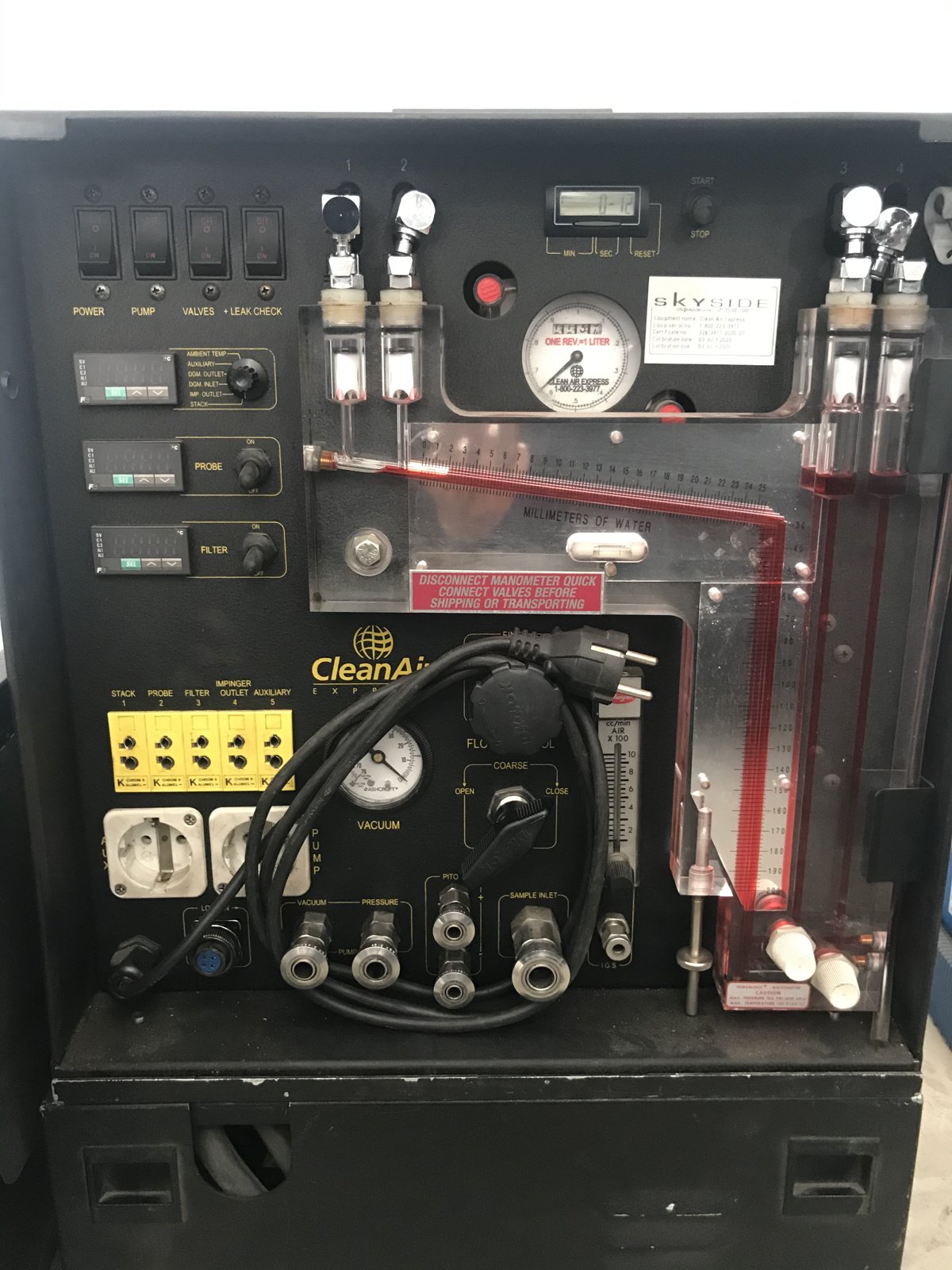
The equipment we use for our Stack monitoring is the Clean Air Express source sampling equipment assembled in America and a Testo340 Gas Analyzer imported from Germany.

Clean Air Express source sampling equipment set up on site
Figure: Clean Air Express source sampling equipment

Costs and budgeting

Stack testing needs to be a part of any emissions-producing facility and should be considered a fixed part of the budget. What you pay for — mobilization, equipment, labour hours and lab analysis of results — is explained in our stack testing costs guide.

What Affects the Cost of Stack Emissions Testing?

Project enquiries

Request a Stack Emissions Testing Quote.

Request a Project Quote