081 476 2296

Understanding Particulate Matter

Particulate matter may be invisible, but its effects aren’t. These tiny pollutants come from industries, vehicles, and wildfires, impacting both health and the environment.

  • Particulate matter (PM) is made up of tiny airborne particles, classified as PM10 (coarse) and PM2.5 (fine).
  • Fine particles can penetrate deep into the lungs and bloodstream, causing respiratory issues and heart disease.
  • Industrial emissions, vehicle exhaust and natural sources like wildfires all contribute to PM pollution.
  • Particulate matter also harms the environment, affecting ecosystems, soil and water.
  • Stack emissions testing and ambient air monitoring give industries measured data to reduce particulate pollution and stay compliant.

Particulate matter

Air pollution isn’t always visible, but its impact is undeniable. One major culprit is particulate matter (PM)—tiny airborne particles classified as PM10 (coarse) and PM2.5 (fine). These particles originate from industrial emissions, vehicle exhaust, and natural sources like wildfires. Fine particles can penetrate deep into the lungs and bloodstream, causing respiratory issues, heart disease, and environmental damage. At KCM Environmental, we conduct emissions testing and air quality monitoring to help industries reduce particulate pollution, ensure compliance, and promote healthier communities. By understanding PM pollution, we can take proactive steps toward cleaner air and a more sustainable future.
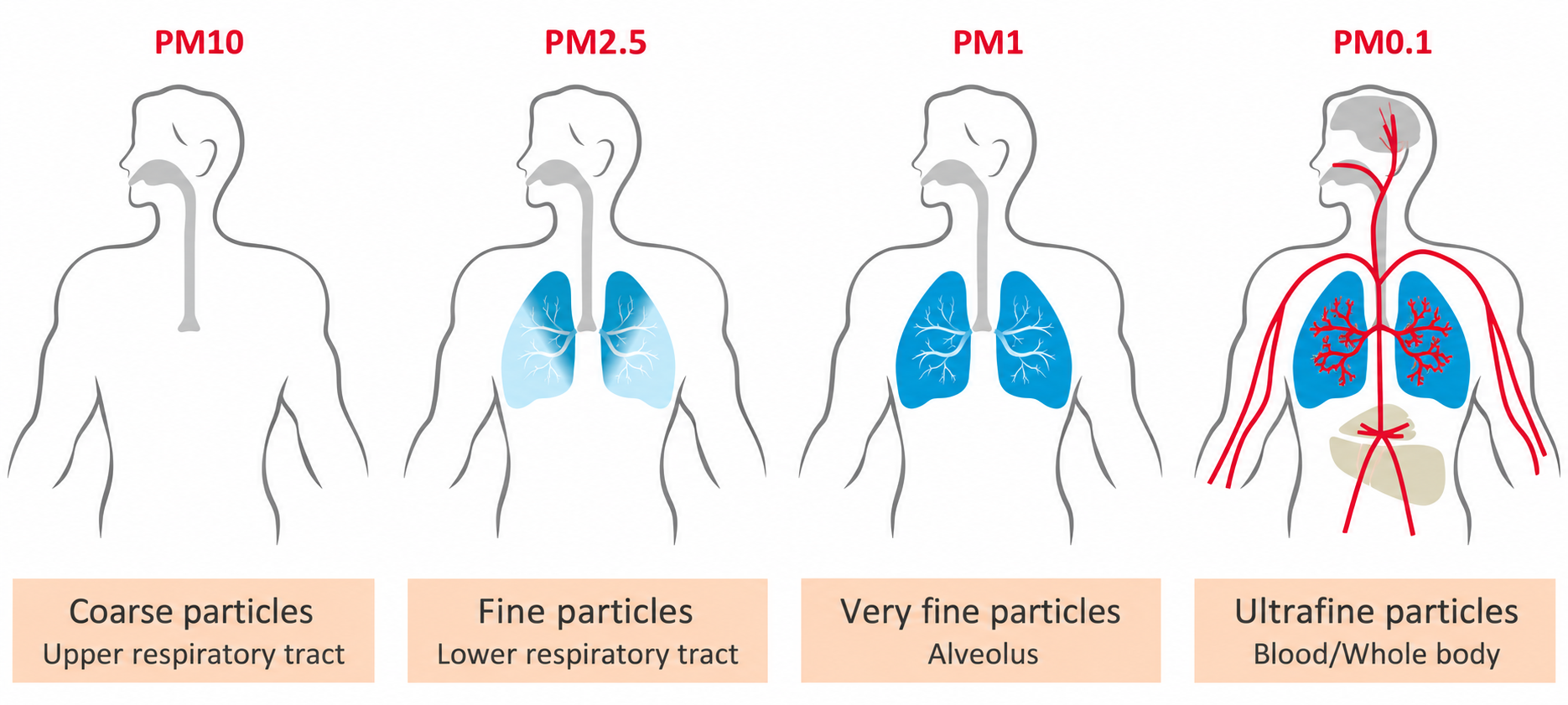
PM10: coarse particles, upper respiratory tract. PM2.5: fine particles, lower respiratory tract. PM1: very fine particles, alveolus. PM0.1: ultrafine particles, blood/whole body.

How particles travel through the body

The diagram traces the pathways particulate matter takes once it is in the air we breathe. Coarser PM10 particles are mostly caught in the nose and throat and are cleared naturally, but they can still irritate airways and worsen asthma.

Fine PM2.5 particles travel further, passing through the airways and reaching the deepest parts of the lungs. From there they can cross into the bloodstream, which is why long-term exposure is linked to heart disease as well as respiratory illness.

Where particulate matter comes from

  • Industrial emissions: stacks, boilers, furnaces and other point sources release particles directly into the air.
  • Vehicle exhaust: diesel engines and traffic are major sources of fine particles in urban areas.
  • Natural sources: wildfires, dust storms and wind-blown soil all add particles to the air.
  • Secondary formation: some particles form in the atmosphere from gases such as sulphur dioxide and nitrogen oxides.

Why particle size matters

PM10 and PM2.5 are named for their maximum diameter in micrometres — a fraction of the width of a human hair. The smaller the particle, the deeper it can travel into the body: PM2.5 reaches the lung's air sacs and can enter the bloodstream, while PM10 is largely trapped higher up in the respiratory system.

Because fine particles stay airborne longer and travel further from their source, they are the greater health concern, and most air quality standards set stricter limits for PM2.5 than for PM10.

Measuring and reducing particulate pollution

Reducing particulate pollution starts with measuring it. Stack emissions testing quantifies the particulate matter leaving an industrial point source, while ambient air monitoring records the concentrations communities are actually exposed to over time — together giving a full picture of both the source and its surroundings.

With measured data in hand, industries can target the controls that make the most difference, demonstrate compliance with their permits and track whether their improvements are working. That is the proactive step toward cleaner air and healthier communities that KCM Environmental supports through testing and monitoring.

Common questions

What is particulate matter?

Particulate matter (PM) is a mixture of tiny airborne particles and droplets small enough to be inhaled. It is classified by size — PM10 (coarse) and PM2.5 (fine) — and comes from industrial emissions, vehicle exhaust and natural sources like wildfires.

Why is PM2.5 more harmful than PM10?

PM2.5 particles are small enough to pass deep into the lungs and cross into the bloodstream, so long-term exposure is linked to both respiratory and heart disease. PM10 is mostly trapped in the nose and throat.

How is particulate matter measured?

Stack emissions testing measures the particulate matter leaving an industrial point source, while ambient air monitoring measures concentrations in the surrounding air over time.

How can industries reduce particulate emissions?

By identifying their emission sources through testing, installing and maintaining appropriate controls such as baghouses and scrubbers, and monitoring the air around their sites to confirm the reductions are real.

Project enquiries

Request an Air Quality Monitoring Quote.

Request a Project Quote