081 476 2296

Understanding the Urban Heat Island Effect

Cities like Durban are heating up due to the Urban Heat Island Effect! But simple solutions, like planting trees, adding green roofs, and incorporating water features can help cool our spaces while improving air quality.

  • Urban areas can be several degrees hotter than the rural land around them, with the biggest difference often felt at night.
  • Hard, dark surfaces such as asphalt, concrete and roofs absorb heat by day and release it slowly after sunset.
  • Higher temperatures speed up the formation of ground-level ozone and can worsen local air quality.
  • Trees, green roofs, reflective and permeable materials and water features all help reduce heat buildup.
  • Ambient air monitoring gives sites and municipalities measured data to plan and track improvements.

The Urban Heat Island Effect

Did you know that cities can be several degrees hotter than surrounding rural areas? This phenomenon, known as the Urban Heat Island Effect (UHIE), occurs due to human activities, dense infrastructure, and reduced vegetation. Asphalt, concrete, and buildings absorb and retain heat, making urban environments significantly warmer—especially at night.

Small changes can have a significant impact! Planting more trees, creating green roofs, using reflective and permeable building materials, and incorporating urban water features like fountains and ponds can all help reduce heat buildup. These solutions not only cool our cities but also enhance air quality and support local biodiversity.
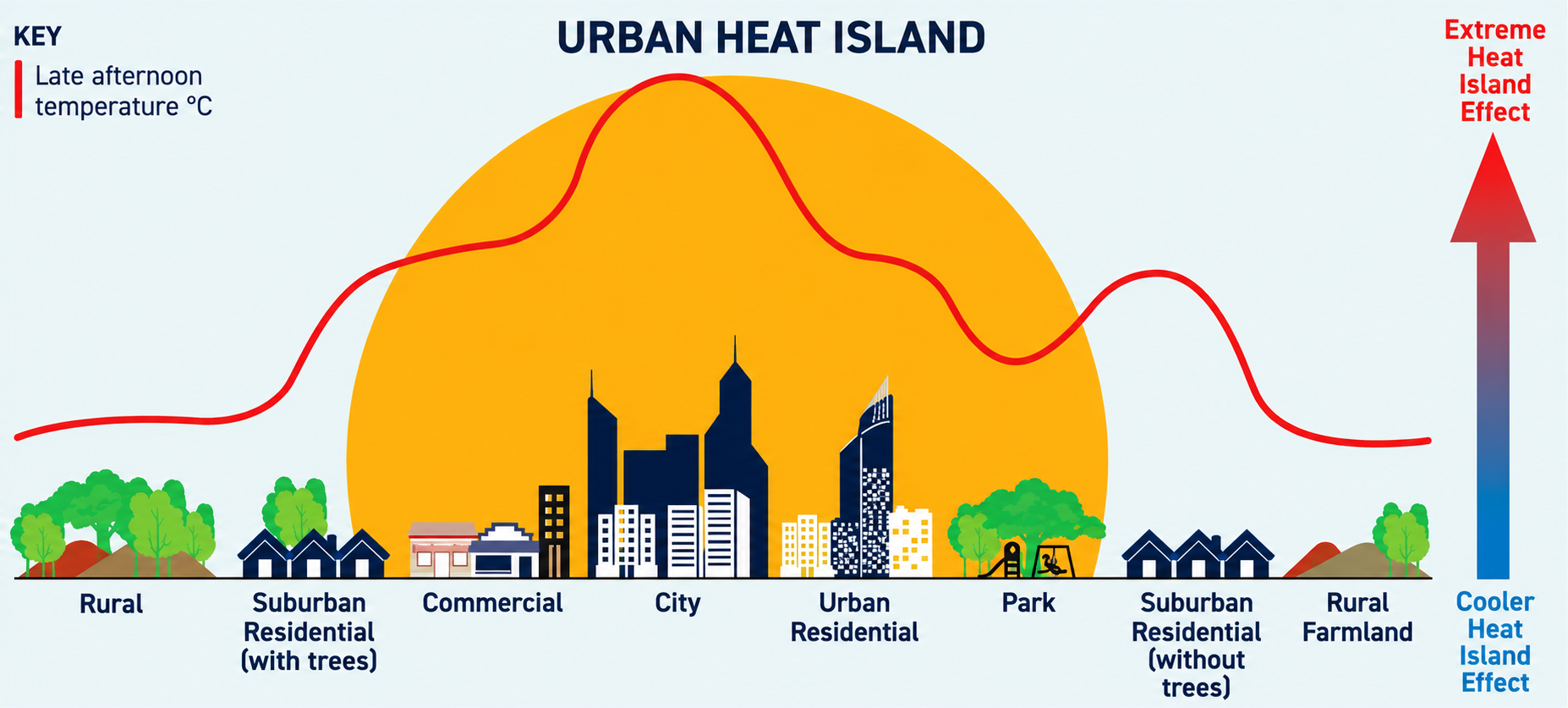
Urban heat island: late afternoon temperature (°C) across rural, suburban residential (with trees), commercial, city, urban residential, park, suburban residential (without trees) and rural farmland areas, from cooler to extreme heat island effect.

Reading the temperature profile

The diagram traces late afternoon temperature across a typical urban area. Temperatures are lowest over rural land and rural farmland, rise through suburban residential areas and commercial districts, and peak over the dense city centre and urban residential areas — the extreme end of the heat island effect.

Two dips stand out. Parks pull the temperature down noticeably even in the middle of built-up areas, and suburban residential areas with trees stay cooler than suburban residential areas without trees. Vegetation and open green space are among the clearest drivers of a cooler local climate.

What causes urban areas to heat up

  • Heat-absorbing surfaces: dark roads, pavements and roofs absorb solar energy during the day and release it slowly into the evening.
  • Less vegetation: fewer trees and less open soil means less shade and less cooling from evaporation and transpiration.
  • Dense building layouts: tall buildings close together trap heat and reduce the airflow that would otherwise carry it away.
  • Waste heat from human activity: vehicles, air conditioning and industrial processes add heat directly to the surrounding air.
  • Sealed ground: impermeable surfaces shed rainwater quickly, leaving little moisture to evaporate and cool the area.

Why it matters for air quality and health

Higher temperatures do more than make a city uncomfortable. Heat and strong sunlight speed up the chemical reactions that form ground-level ozone from vehicle and industrial emissions, so hot urban areas can experience poorer air quality on the warmest days.

Warmer conditions also raise demand for cooling, which increases energy use and the associated emissions. Prolonged heat places added strain on vulnerable people, including the elderly, young children and those with respiratory or heart conditions.

Practical ways to reduce the effect

  • Plant trees and maintain green space to provide shade and evaporative cooling.
  • Install green roofs and vegetated walls on suitable buildings.
  • Use reflective (cool) roofing and paving materials that absorb less solar heat.
  • Choose permeable paving so rainwater can soak in and evaporate.
  • Include water features such as fountains and ponds in urban and site design.
  • Reduce waste heat and emissions from vehicles, equipment and industrial processes.

Measuring the improvement

Changes to land use and site design are easier to justify when they are backed by measured data. Ambient air monitoring records pollutant concentrations and conditions around a site or community over time, helping organisations understand local air quality and track whether improvements are having the intended effect. Where new developments or land-use changes are planned, environmental authorisation processes are the point at which these factors are assessed.

Common questions

What is the Urban Heat Island Effect?

It is the tendency of cities and built-up areas to be several degrees warmer than surrounding rural areas, caused by human activities, dense infrastructure and reduced vegetation.

Why is the effect often strongest at night?

Asphalt, concrete and buildings absorb heat during the day and release it slowly after sunset, so urban areas cool down far more slowly than open countryside.

Does the heat island effect affect air quality?

Yes. Higher temperatures speed up the formation of ground-level ozone and increase energy demand for cooling, both of which can worsen local air quality.

What reduces the Urban Heat Island Effect?

Planting trees, creating green roofs, using reflective and permeable building materials and adding water features such as fountains and ponds all help reduce heat buildup.

Project enquiries

Request an Ambient Air Monitoring Quote.

Request a Project Quote